
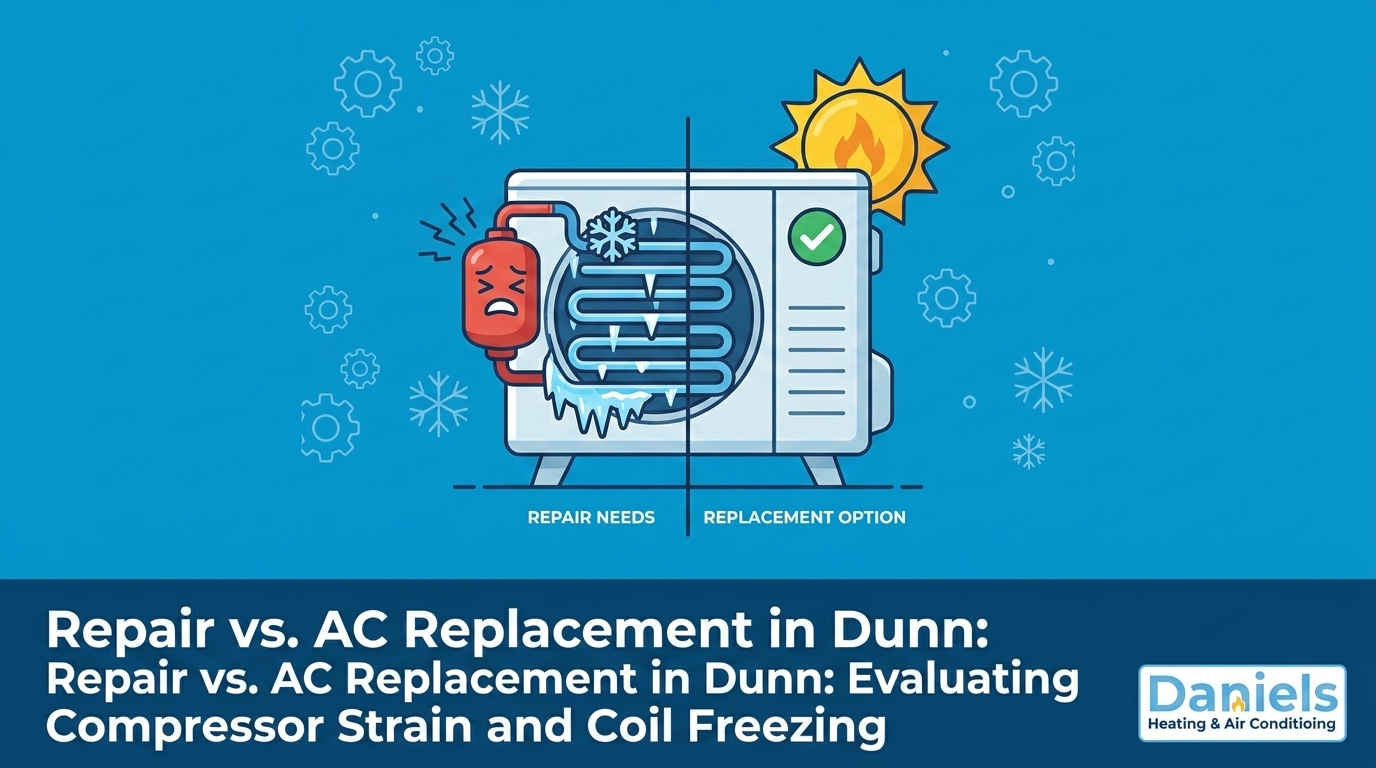
Repair vs. AC Replacement in Dunn: Evaluating Compressor Strain and Coil Freezing
Is It Time for an AC Replacement in Dunn? Diagnosing Warm Air and Freezing
When searching for reliable home maintenance tips and troubleshooting, a common myth our team at Daniels Heating & Air Conditioning frequently encounters is that a freezing air conditioner just needs to be turned off for a few hours to "reset" itself. The reality is far more complex. If your system is freezing up or blowing warm air during peak summer cooling, you are not dealing with a temporary glitch. You are witnessing a system under severe mechanical strain.
Turning the thermostat off will certainly melt the ice temporarily, but it does absolutely nothing to resolve the underlying cause. The moment the system kicks back on, the exact same conditions that caused the freeze will begin forming new ice. Allowing this cycle to continue forces your cooling equipment to work exponentially harder, turning a potentially minor issue into a catastrophic mechanical failure.
The critical decision point: As a homeowner, you must determine whether the issue stems from a basic airflow restriction that you can correct, or a deeper mechanical failure that requires intervention. Misdiagnosing a refrigerant leak as a simple filter problem can lead to a burned-out compressor—the most expensive component in your entire system. Objective diagnostics are necessary to protect your equipment from permanent damage.
If you are concerned about the health of your cooling equipment, exploring modern air conditioning systems can provide a baseline for what to expect from a fully functional unit.
The Mechanics of Evaporator Coil Freezing
To understand why an air conditioner freezes, you have to look at how it operates. Your system does not actually "create" cold air; it removes heat from the air inside your house. The indoor evaporator coil is filled with extremely cold liquid refrigerant. As warm indoor air blows across this coil, the refrigerant absorbs the heat, turning into a gas that travels outside to release that heat.
When airflow is restricted—whether by a clogged filter, blocked return vents, or a failing blower motor—there is not enough warm air passing over the coil. Without that constant supply of heat to absorb, the temperature of the refrigerant drops rapidly. The coil's surface temperature plummets below 32°F. At this point, a chain reaction begins.
The natural moisture in your indoor air condenses onto the freezing metal coil. Because the coil is below freezing, that condensation instantly turns to frost. As the frost thickens into a solid block of ice, it acts as an insulator, further restricting whatever little airflow remained. The system continues to run, but no heat is being absorbed, meaning the air blowing out of your vents gradually turns warm. Meanwhile, the outdoor compressor is forced to run continuously, desperately trying to satisfy the thermostat setting.
How Latent Heat Impacts Your Cooling Cycle
Dunn experiences hot, highly humid subtropical summers. This climate creates an intense latent heat load on your cooling system. Latent heat refers to the moisture or humidity in the air, whereas sensible heat refers to the actual temperature you read on a thermometer.
Before your air conditioner can effectively lower the temperature of the room, it must first remove the heavy moisture from the air. High humidity means the system is working overtime just to dehumidify your home. When you combine this massive moisture load with restricted airflow, the condensation rate on the evaporator coil skyrockets. The heavy moisture turns into rapid, aggressive ice accumulation. What might take days to freeze in a dry climate can freeze solid in a matter of hours during a Dunn summer heatwave.
Safe DIY Troubleshooting vs. Professional Diagnostics
When your system begins blowing warm air or showing signs of frost, there is a strict dividing line between what you can safely check yourself and what requires a licensed professional. Overstepping this line is dangerous and often leads to more expensive repairs.
The safe approach: Always start by checking your air flow. Turn the system off at the thermostat immediately to let any ice melt. Check your air filter; a severely clogged filter is the number one cause of airflow restrictions. Next, walk through your home and ensure all supply and return vents are open and unblocked by furniture or rugs.
If the filter is clean and the vents are clear, the problem is mechanical. This is where DIY stops. Handling high-voltage electrical components or pressurized refrigerants requires specialized training, gauges, and licensing.
• Air Filter Replacement — Safe for DIY?: Yes — Why It Matters: Dirty filters choke airflow, causing the coil temperature to drop and ice to form rapidly.
• Vent Inspection — Safe for DIY?: Yes — Why It Matters: Closed or blocked vents disrupt the return air balance, starving the system of the warm air it needs to function.
• Refrigerant Level Checks — Safe for DIY?: No — Why It Matters: Low refrigerant causes pressure drops that freeze the coil. Handling refrigerant requires EPA certification and specialized gauges.
• Blower Motor Diagnostics — Safe for DIY?: No — Why It Matters: A failing motor won't push enough air. Testing it involves interacting with high-voltage capacitors and wiring.
• Compressor Health Testing — Safe for DIY?: No — Why It Matters: Requires advanced electrical diagnostics to read amp draws and test internal valve integrity.
Never attempt to add refrigerant yourself. Overcharging a system is just as dangerous as undercharging it, and both scenarios can destroy the compressor.
Evaluating Persistent Compressor Strain
The compressor is the heart of your cooling system. It is a large, powerful pump located in the outdoor unit, responsible for circulating refrigerant through the lines. It is also the most expensive single component in the entire setup. When a system freezes or short cycles repeatedly, the compressor bears the brunt of the damage.
One of the most dangerous consequences of a frozen evaporator coil is a phenomenon called "liquid slugging." Compressors are designed to compress gas, not liquid. When the indoor coil freezes, the refrigerant cannot absorb heat, meaning it never boils into a gas. It travels back to the outdoor compressor as a cold liquid. When this liquid hits the compressor's internal valves, it causes violent mechanical stress, washing away lubricating oils and causing irreversible damage to the internal mechanics.
Signs your compressor is failing:
• Grinding or screeching noises: A sign that internal bearings or valves are breaking down due to lack of lubrication.
• Hard starting: The unit stutters, dims the house lights, or struggles to turn on, indicating high electrical draw.
• Sudden energy bill spikes: The compressor is working twice as hard to produce half the cooling output.
• Frequent tripped breakers: The motor is pulling too many amps because it is overheating or seizing up.
Rapid intervention is necessary to save the system from total failure. For example, our team at Daniels Heating & Air Conditioning frequently responds to critical cooling emergencies during peak summer heatwaves. Recently, we assisted a local homeowner experiencing a sudden weekend outage. Our technician arrived promptly, diagnosed a failing fan motor that was restricting airflow, and had the exact replacement part on the truck. We were able to get the system back online within an hour, resolving the issue before liquid slugging could destroy the compressor. Scheduling a professional AC inspection at the first sign of trouble can prevent a minor part failure from escalating into a total system replacement.
Repair vs. Replace: Making the Final Call
When faced with a major mechanical failure, such as a dead compressor or a severe refrigerant leak in the evaporator coil, you must decide whether to repair the aging unit or invest in a full replacement. This decision matrix relies on objective data regarding the age, condition, and efficiency of your current equipment.
At Daniels Heating & Air Conditioning, we rely on comprehensive home comfort repair diagnostics that prioritize your best interest. Instead of applying immediate sales pressure, our evaluation provides you with objective data—such as static pressure readings, electrical amp draws, and refrigerant subcooling metrics—so you can make an informed, analytical decision.
Consider the age factor. Most standard cooling systems have an expected lifespan of 10 to 15 years. If your unit is approaching or exceeding this age, sinking money into a major repair is often a poor investment. The "50% Rule" is a standard industry benchmark: if the cost of the repair exceeds 50% of the value of a new system, replacement is the financially sound choice.
Furthermore, older systems likely use phased-out refrigerants like R-22. Because R-22 is no longer manufactured, its price has skyrocketed. Repairing a leak in an R-22 system means paying premium prices for scarce refrigerant, with no guarantee that another leak won't develop next month.
Pros of Replacing an Aging System:
• Eliminates the cycle of frequent, expensive breakdowns.
• Upgrades your home to environmentally friendly, current-generation refrigerants.
• Restores reliable, consistent cooling during peak summer heatwaves.
• Provides the peace of mind that comes with a fresh manufacturer warranty.
Another local homeowner in our Goldsboro and Dunn service area faced this exact crossroad during a recent peak-heat stretch. Their aging unit required frequent repairs, leading them to opt for a full replacement. Our technicians cleanly dismantled and removed the old equipment, professionally installing a new unit that immediately resolved the recurring breakdowns and restored their comfort.

Upgrading to Modern Efficiency Standards
If the data points toward replacement, the silver lining is the massive leap in technology over the last decade. Modern, high-efficiency systems reduce cooling energy usage significantly compared to aging units. The Seasonal Energy Efficiency Ratio (SEER2) standards mandate much higher baseline efficiencies, meaning even a base-model new unit will likely outperform a premium unit from fifteen years ago.
One of the most impactful advancements is the development of variable-speed compressors. Older single-stage compressors only know two speeds: 100% on, or 100% off. They blast cold air until the thermostat clicks, then shut down. Variable-speed technology allows the compressor to modulate its capacity, running at 30%, 50%, or 70% depending on the exact needs of the house.
This modulation is incredibly effective for managing humidity. By running longer cycles at a lower speed, the system continuously pulls moisture out of the air without overcooling the house. You feel more comfortable at 74°F with low humidity than you do at 70°F with high humidity. Furthermore, pairing these modern units with advanced air distribution zoning systems ensures that every room receives consistent airflow, eliminating hot and cold spots throughout your floor plan.
Secure Reliable Comfort for Your Dunn Home
Addressing warm air or freezing issues immediately is the best way to protect your home and your wallet. Ignoring the symptoms forces your equipment to operate under extreme strain, accelerating wear and tear until a total breakdown is inevitable.
Do not wait until you are stranded without cooling in the middle of a July heatwave. Rely on our objective local experts to perform a thorough, data-driven diagnostic of your equipment. Whether the solution is a simple motor replacement or a full system upgrade, making an informed decision today ensures your home remains comfortable all season long. Reach out for professional AC services in Dunn to schedule an evaluation and secure your indoor climate.
Frequently Asked Questions
Why is my AC blowing warm air in the summer?
Warm air usually indicates a loss of heat absorption capability. This happens when the system is low on refrigerant, the compressor is failing to circulate the refrigerant, or a frozen evaporator coil is blocking heat transfer. You should check your air filter first, but if the filter is clean, a professional diagnostic is required to locate the mechanical failure.
What causes an AC coil to freeze?
A coil freezes when there is a lack of warm airflow passing over it, or when the system is low on refrigerant. Without enough warm air to absorb, the refrigerant drops below freezing, causing the ambient humidity to condense and freeze on the metal fins. Dirty filters, blocked vents, and failing blower motors are the most common airflow culprits.
How do I unfreeze my AC unit safely?
The only safe way to unfreeze the unit is to turn the thermostat's cooling function to "OFF" and switch the fan setting to "ON." This stops the cooling cycle while circulating warm indoor air over the coil to melt the ice naturally. Never use sharp objects, heat guns, or hair dryers to chip away the ice, as this will puncture the delicate refrigerant lines.
Why is my AC running but not cooling?
If the outdoor unit is running but the house isn't cooling, the system is likely struggling with a severe airflow restriction, a frozen indoor coil, or a refrigerant leak. The compressor is working to pump refrigerant, but the thermal transfer process inside the house has been interrupted. Shut the system down to prevent compressor damage and check your filter.
How do I know if my AC compressor is bad?
A failing compressor often produces loud grinding, clanking, or screeching noises during operation. You may also notice the system struggling to start (hard starting), tripping the circuit breaker repeatedly, or causing a sudden, unexplained spike in your monthly energy bills. A technician must test the electrical amp draw to confirm compressor failure.
When should I replace my AC unit?
You should consider replacing your unit when it is over 10 to 15 years old, requires frequent repairs, or if a single repair cost exceeds 50% of the price of a new installation. Upgrading is also recommended if your current system uses obsolete R-22 refrigerant, as fixing leaks in these older systems has become prohibitively expensive.
Can high humidity cause my AC to freeze up?
High humidity alone does not cause freezing, but it drastically accelerates the freezing process if an underlying airflow or refrigerant issue exists. The heavy moisture in the air provides more water vapor to condense onto the abnormally cold coil, turning a minor frost issue into a solid block of ice very rapidly.
hear what our satisfied
clients have to say


Service areas