
Diagnosing Short-Cycling Heat Pumps During Mild October Afternoons in Dudley, NC
Why Your Heat Pump is Struggling with Dudley's October Afternoons
If you find yourself diagnosing short-cycling heat pumps during mild October afternoons in Dudley, NC, you already know how incredibly frustrating that rapid on-and-off clicking can be. Your system powers up, runs for just a few minutes, and abruptly shuts down before the house even feels comfortable. At Daniels Heating And Air Conditioning, our team receives countless calls about this exact issue every fall. For many homeowners, this constant starting and stopping triggers an immediate wave of anxiety, making you wonder if the entire compressor is failing right before the bitter cold of winter arrives. Fortunately, navigating these seasonal HVAC issues often comes down to distinguishing between a major mechanical failure and a simple thermostat calibration issue. When you rely on professional HVAC services, you get the reassurance that an expert assessment can quickly pinpoint the root cause. A pattern we see often is that the October transition weather—with its warm days and chilly nights—is simply confusing your system's sensors, rather than signaling a catastrophic breakdown.
Understanding Eastern NC's Transition Weather Stress on HVAC Systems
October in Eastern North Carolina creates a highly specific set of environmental triggers that can push your climate control equipment to its limits. During this time of year, our technicians know it is completely normal to see afternoon temperatures climbing into the upper 70s or low 80s, only to plummet into the 40s or 50s once the sun goes down. This specific climate context forces your system to rapidly switch its operational demands, sometimes multiple times within a single 24-hour period. In our years of service, we've noted that homes in Goldsboro, Mt. Olive, Pikeville, Princeton, and Newton Grove all experience these exact same microclimate challenges. Heat pumps are fundamentally designed for steady, consistent operation. When they are subjected to rapid, unpredictable environmental fluctuations, they struggle to find an operational rhythm.
The 30-Degree Daily Temperature Swing
The typical October temperature arc in our region creates immense thermal load changes on a residential property. At 2:00 PM, the sun is beating down on your roof, warming the attic and transferring heat into your living spaces. Your system recognizes this heat gain and attempts to cool the home. However, our team frequently observes that by 10:00 PM, the ambient outdoor temperature has dropped by 30 degrees, and the thermal load completely reverses. Your house is now losing heat to the cool night air, prompting the system to switch gears. This massive daily temperature swing means your equipment never gets a prolonged break, and the internal components are constantly shifting between cooling and heating expectations.
How Microclimates Affect Heat Pump Sensors
Ambient outdoor temperatures interact directly with the outdoor unit's sensors, while sunlight interacting with your home creates indoor microclimates. Rapid warming in the afternoon sun creates conflicting data for the system. For instance, the outdoor sensor might register a mild 72 degrees, but intense sunlight pouring through a south-facing window might push the indoor thermostat reading to 78 degrees. The system receives a sudden demand for cooling, but because the overall outdoor environment is still relatively mild, the cooling demand is satisfied almost immediately. The system shuts off, only to be triggered again minutes later as the localized heat from the window persists. From what we see in the field, this conflicting data is a primary driver of the October transition weather causing erratic system behavior.
What Constitutes Short-Cycling in Mild Fall Weather?
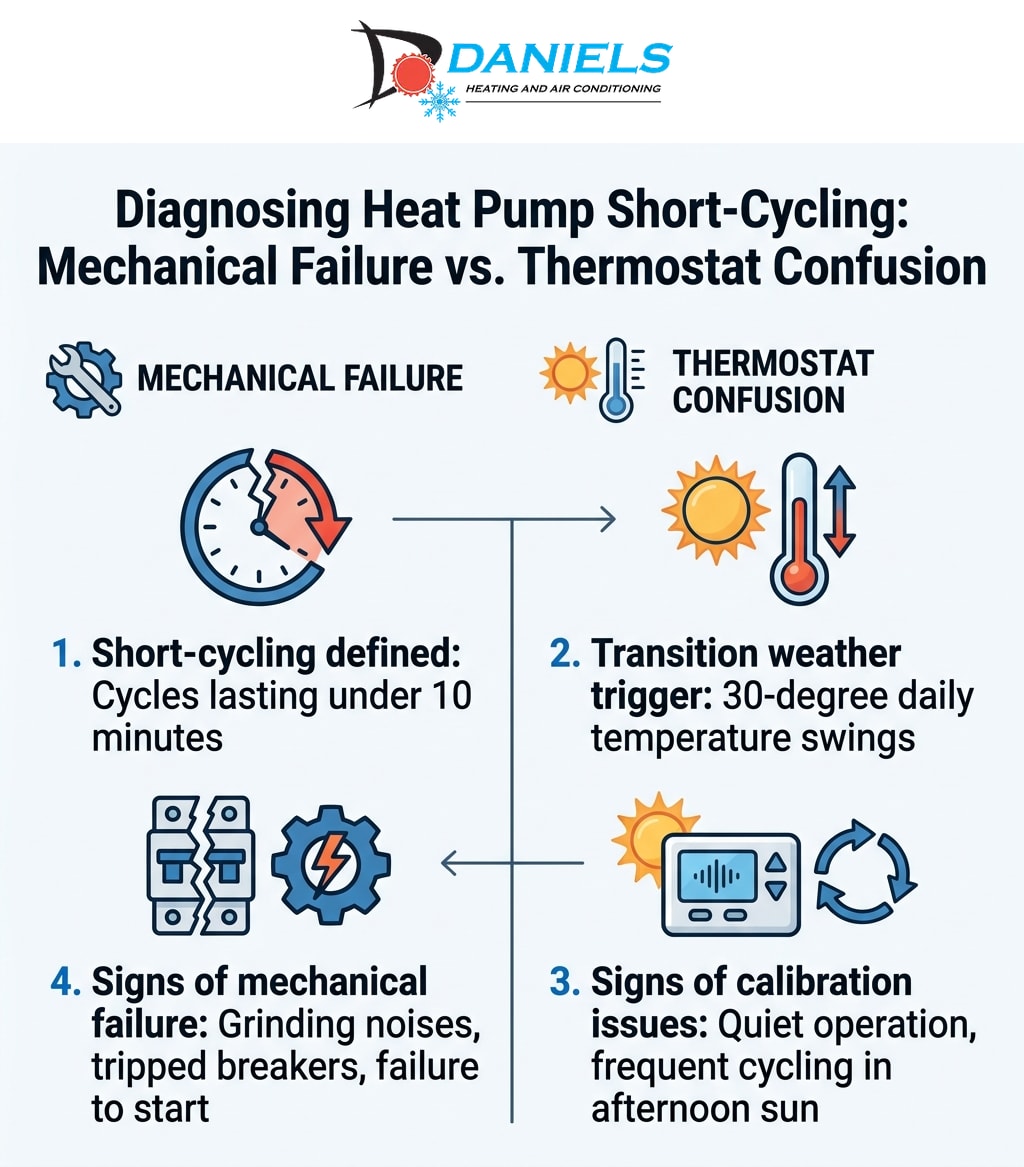
To understand what is happening to your system, it is important to explicitly define what short-cycling actually means. Short-cycling occurs when a heating or cooling cycle terminates prematurely, typically running for less than 10 minutes before shutting down. According to Department of Energy (DOE) guidelines regarding optimal heat pump operation, a healthy system needs time to reach its steady-state efficiency. When a cycle is cut short, the system never reaches this peak operational phase. If you are dealing with this frustrating issue, seeking heat pump repair and installation expertise is the best way to evaluate your equipment's cycle times. Our experienced installers always emphasize how crucial it is to differentiate between normal mild-weather operation—which naturally features shorter but complete cycles—and actual destructive short-cycling that damages your equipment.
Defining the 10-Minute Cycle Threshold
Establishing a baseline for a healthy cycle duration is the first step in diagnosing the problem. A properly functioning heat pump should typically run for 15 to 20 minutes per cycle during moderate weather to effectively manage both temperature and humidity. To accurately time your system's cycles, we recommend standing near a vent or the thermostat and starting a timer the moment you hear the blower motor engage. Stop the timer when the system completely powers down. If this duration consistently falls under the 10-minute mark, your system is truly short-cycling.
The Hidden Costs of Premature Cycle Termination
The negative impacts of short-cycling extend far beyond a slightly uncomfortable living room. When our technicians inspect systems that turn on and off rapidly, we routinely see severe mechanical and electrical strain:
• Motor burnout: The highest amount of electrical current is drawn during the startup phase. Frequent startups overheat the blower motor and compressor.
• Capacitor failure: The capacitors, which provide the initial jolt of energy to start the motors, wear out significantly faster when forced to discharge every five minutes.
• Plummeting energy efficiency: Because the system never reaches its steady-state operating phase, it uses maximum electricity for minimum temperature change, leading to surprisingly high utility bills.
• Poor indoor air quality: Short cycles do not provide enough time for the indoor air to circulate fully through the filtration system, leaving dust and allergens suspended in your living spaces.
The Thermostat Deadband Dilemma
At the heart of many mild-weather cycling issues is a technical concept known as the "thermostat deadband." The deadband is the specific temperature range required before a system switches modes or initiates a new cycle. For example, if your thermostat is set to 72 degrees, the deadband might dictate that the indoor temperature must rise to 74 degrees before cooling kicks in, or drop to 70 degrees before heating begins. When deadbands are improperly set, the thermostat sends rapid, conflicting signals during transition weather. When homeowners call us for Dudley, NC heating and cooling assistance, our technicians frequently find that adjusting this deadband is the key to restoring system stability.
Heating vs. Cooling Mode Confusion
We always advise our customers that leaving a thermostat in "Auto" mode during days with extreme temperature fluctuations carries significant risks. In Auto mode, the thermostat is authorized to switch between heating and cooling automatically based on the indoor temperature. During a mild October afternoon, the indoor temperature might hover right at the set point. A slight breeze or a cloud passing over the sun can cause the indoor temperature to fluctuate by a single degree. If the deadband is too narrow, the system can get stuck in a frustrating loop, trying to simultaneously heat and cool the home as it bounces on and off every few minutes to chase a moving target.
Sensor Misreads in the Afternoon Sun
Localized heat sources create false readings that compound the deadband dilemma. If sunlight hits the thermostat directly during the late afternoon, the internal sensor will read a temperature much higher than the actual ambient temperature of the room. The thermostat panics and commands the heat pump to cool the space immediately. However, the rest of the house is perfectly comfortable. The system runs for just a few minutes, satisfies the false demand at the thermostat, and shuts down. The compounding effect of mild outdoor weather mixed with uneven indoor solar heating creates a perfect storm for sensor confusion and rapid cycling, a scenario our team resolves daily.
Is It a Failing Compressor or Just Calibration Confusion?
The biggest fear for homeowners in Dudley, Goldsboro, and surrounding Wayne County areas is that mild weather short-cycling means the compressor is dying. While rapid cycling should never be ignored, in our experience, it is frequently a non-catastrophic issue. By comparing the signs of a catastrophic failure against benign calibration issues, you can better understand what your system is trying to tell you. Professional diagnostics are always required to rule out internal electrical issues before they worsen, but knowing the difference can provide peace of mind. For more insights into these symptoms, troubleshooting common HVAC warning signs can help you stay informed.
Recognizing Catastrophic Warning Signs
Genuine mechanical failure usually announces itself with aggressive symptoms. If you notice any of the following, our technicians recommend immediately shutting off the system at the breaker to prevent further damage:
• Loud grinding or screeching noises: These sounds indicate metal-on-metal friction, often meaning the compressor's internal bearings are failing.
• Failure to start: If the thermostat clicks but the outdoor unit merely hums or clicks without the fan spinning, the compressor or capacitor may be dead.
• Tripped circuit breakers: A system that repeatedly trips the electrical panel breaker is pulling too much amperage, a classic sign of an electrical short or a seized compressor.
• Acrid electrical smells: The scent of burning plastic or ozone near the vents or the indoor air handler points to melting wires or failing motors.
Why Mild Weather Triggers False Alarms
Conversely, symptoms of calibration confusion are often much quieter. The system sounds completely normal when it runs; it simply runs too frequently. You might notice that the system operates perfectly during the chilly night, running long, steady heating cycles, but begins short-cycling in the warm afternoon sun. In some cases, the system's internal safety limit switches can be tripped by the rapid cycling caused by a confused thermostat. This mimics a breakdown because the system locks itself out to prevent damage. Our professionals can reset and recalibrate these systems without requiring new major parts, proving that the issue was merely a false alarm triggered by the weather.
• Operational Noise — Likely Calibration Issue: Quiet, normal airflow sounds — Potential Mechanical Failure: Loud grinding, screeching, or buzzing
• Time of Day — Likely Calibration Issue: Only happens during warm afternoons — Potential Mechanical Failure: Happens constantly, day or night
• Electrical Impact — Likely Calibration Issue: Breakers remain untripped — Potential Mechanical Failure: Repeatedly trips the circuit breaker
• Air Temperature — Likely Calibration Issue: Air feels properly heated or cooled — Potential Mechanical Failure: Air feels lukewarm or room temperature
The Science of Professional Thermostat Recalibration
When calibration confusion is the culprit, professional thermostat recalibration is the necessary, safe solution. A licensed HVAC technician performs a highly detailed diagnostic process to restore your system's rhythm. They begin by adjusting the temperature swing settings within the thermostat's hidden installer menus. Next, they verify the accuracy of the indoor and outdoor sensors, ensuring that the data being sent to the control board matches the actual ambient conditions. Finally, they check the low-voltage wiring connections to rule out any intermittent communication drops between the thermostat and the air handler. As a local provider with a deep understanding of Dudley's microclimate, our team at Daniels Heating And Air Conditioning has specific expertise in safely recalibrating thermostats for transition season behavior, ensuring your system operates flawlessly regardless of the weather outside.
Why Transition Seasons Require Expert Adjustment
Setting the correct temperature swing or differential requires technical precision. An expert matches the thermostat's algorithm to the specific make and model of your heat pump. Every manufacturer has distinct guidelines for how their equipment should cycle, and we often find that generic thermostat settings fail to account for these nuances. Proper calibration stabilizes the system for the specific microclimate demands of Eastern NC, ensuring that the equipment is optimized for both the current mild fall weather and the upcoming winter freeze.
Avoiding the Risks of DIY Thermostat Tweaks
We strongly advise against any DIY deadband adjustments or opening the thermostat housing yourself. Accessing hidden installer menus without proper training is incredibly risky. Incorrect settings can force the compressor to run outside of its safe operational parameters, potentially causing permanent damage to the motor windings. Furthermore, probing inside a live thermostat can easily cause an electrical short that fries the main control board, turning a simple recalibration appointment into an expensive parts replacement that may void your manufacturer warranty.
Proactive Pre-Winter Heat Pump Strategies for Wayne County
Our technicians consider October the critical window for pre-winter heating startup and inspection. Resolving mild-weather short-cycling now prevents emergency breakdowns during the freezing temperatures of January. When a system is allowed to short-cycle throughout the fall, the constant starting and stopping weakens the capacitors and contactors. When the first major cold snap hits and the system is suddenly demanded to run continuously for hours, those weakened components fail under the stress. A preventative maintenance plan plays a vital role in keeping sensors clean, airflow unrestricted, and electrical connections tight.
Transitioning from Fall Maintenance to Winter Readiness
At Daniels Heating And Air Conditioning, we remind homeowners that professional maintenance goes far beyond changing an air filter. Non-DIY maintenance benefits include professional coil cleaning, which ensures optimal heat transfer, and precise refrigerant level checks. If your system is aging and struggling to maintain efficiency even after recalibration, it might be time to consider an upgrade. Generally applicable energy rebates or federal tax credits may apply to upgrading inefficient, aging systems to modern, high-efficiency heat pumps, helping offset the investment. Finally, remember that your indoor air quality (IAQ) is directly impacted by system cycling behavior. A properly calibrated system runs long enough to pull humidity and airborne particulates out of your living space, ensuring your home remains healthy and comfortable all winter long.
Frequently Asked Questions
Why is my heat pump short cycling during mild weather?
Your heat pump is likely short cycling because mild weather creates rapid temperature swings that confuse the thermostat sensors. When the outdoor temperature fluctuates between warm afternoons and chilly nights, the system struggles to determine a steady heating or cooling load. Our team frequently sees this sensor confusion cause the equipment to turn on and off rapidly before completing a full cycle.
How does a thermostat cause short cycling?
A thermostat causes short cycling when its temperature deadband or swing settings are improperly calibrated for the current weather conditions. If the deadband is too narrow, the thermostat reacts to every minor temperature fluctuation in the room, commanding the system to start and stop constantly. Direct sunlight hitting the thermostat can also cause false readings that trigger premature cycles.
Does short cycling mean my heat pump compressor is bad?
Short cycling does not automatically mean your heat pump compressor is bad, especially during transition seasons. Often, it is simply a calibration issue or a dirty sensor causing the rapid cycling. However, if the short cycling is accompanied by loud grinding noises, tripped breakers, or a complete failure to start, our technicians warn that it strongly points toward a failing compressor.
Why does my heat pump run constantly in the fall?
Your heat pump might run constantly in the fall if the thermostat is set to "Auto" mode and the indoor temperature is hovering right at the set point. The system gets stuck in a loop, trying to alternate between heating and cooling to maintain a perfectly rigid temperature against fluctuating outdoor weather. A professional recalibration by our team can adjust the settings to give the system proper resting periods.
Can a dirty air filter cause my heat pump to turn on and off rapidly?
Yes, a severely dirty air filter can absolutely cause your heat pump to turn on and off rapidly. A clogged filter restricts airflow over the indoor coil, causing the internal safety limit switches to trip to prevent overheating or freezing. Once the system shuts down and the pressure normalizes, it attempts to restart, creating a continuous short-cycling loop.
How often should a heat pump cycle during an October afternoon?
During a mild October afternoon, a properly functioning heat pump should typically cycle two to three times per hour. Each cycle should last roughly 15 to 20 minutes to ensure adequate temperature control and humidity removal. If your system is cycling more than four times an hour or running for less than 10 minutes at a time, it requires professional assessment.
Diagnosing short-cycling heat pumps during mild October afternoons in Dudley, NC, does not have to end in panic. Understanding how transition weather affects your thermostat is the first step toward restoring your home's comfort. By relying on a clear, reassuring explanation and scheduling a professional thermostat recalibration with our experienced team, you can stop the rapid cycling, protect your equipment from unnecessary wear, and ensure your system is fully prepared for the cold winter ahead. If you need heat pump repair and installation support, reach out to Daniels Heating And Air Conditioning today to secure your peace of mind.
hear what our satisfied
clients have to say


Service areas