
Upgrading to a Dual-Fuel System vs. Standard Heat Pump: A Cost Analysis for Smithfield, NC Homes
Navigating Your Fall Heating Upgrade Decision
At Daniels Heating And Air Conditioning, we often encounter a persistent myth that researching Upgrading to a Dual-Fuel System vs. Standard Heat Pump: A Cost Analysis for Smithfield, NC Homes will automatically point toward basic equipment because our winters are supposedly too mild. The truth is, as our technicians know all too well, Eastern North Carolina weather is highly unpredictable. While our afternoons might feel pleasant, those sharp nighttime temperature drops tell a different story. If your current system struggled to keep your house warm last winter, you are likely facing a major decision before the cold weather returns. Deciding whether the long-term utility efficiency of a hybrid system justifies a specific upgrade requires looking past the initial installation and understanding how these systems actually operate under stress.
For homeowners ready to secure their winter comfort, comparing modern heating systems is the first step toward a successful heat pump replacement.
As you prepare for an October pre-winter replacement, evaluating a dual-fuel system vs standard heat pump upgrade means understanding exactly how your equipment responds when the thermometer plummets. This efficiency guide will break down the mechanics, the operational differences, and the long-term value of both options so you can make an informed choice for your household.
How Standard Heat Pumps Perform in Eastern North Carolina
To understand why a heating upgrade matters, you first need to understand how a baseline heat pump operates. Unlike a furnace that burns fuel to create heat, a heat pump uses electricity and refrigerant to move heat from one place to another. Even when it feels cold outside, there is still thermal energy in the ambient air. A standard heat pump absorbs that outdoor heat, compresses the refrigerant to raise its temperature, and transfers that warmth inside your home.
The Challenge of Dropping Temperatures
The problem: This heat transfer process works flawlessly when outdoor temperatures remain in the 40s and 50s. However, as the air gets colder, there is less ambient heat available to extract. The heat pump has to run longer and work harder to pull enough warmth indoors to satisfy your thermostat.
The cause: While daytime temperatures in Goldsboro, Mt. Olive, Pikeville, Dudley, Princeton, and Newton Grove are often mild, our field crews regularly see the effects of our region's frequent nighttime drops into the 30s. During these freezing nights, a standard heat pump begins to lose its optimal efficiency. The outdoor coil can actually freeze over as it attempts to extract heat from near-freezing air. When this happens, the system shifts into a "defrost cycle," temporarily reversing its operation to melt the ice on the outdoor unit.
The solution: To prevent cold air from blowing into your home during a defrost cycle, and to supplement the struggling heat pump, the system activates auxiliary electric heat strips. These heat strips function much like the glowing coils inside a giant toaster. While they do successfully warm your home, they require a massive amount of electricity to operate. Relying heavily on auxiliary heat strips throughout the winter leads to significant operational strain and heavily impacts your monthly utility usage. Standard systems are excellent for mild fall days, but we consistently see them face distinct mechanical challenges during mid-winter freezes across the Smithfield and Goldsboro service areas.
The Mechanics of a Dual-Fuel System and the 'Balance Point'
If standard heat pumps struggle during freezing nights, what is the alternative? A dual-fuel system, often referred to as a hybrid heating system, combines two distinct pieces of equipment: an electric heat pump and a gas furnace. Instead of relying on energy-heavy electric resistance strips for backup heat, this system uses a high-efficiency gas furnace to take over when the weather gets too cold for the heat pump to operate effectively.
Understanding the Switchover Temperature
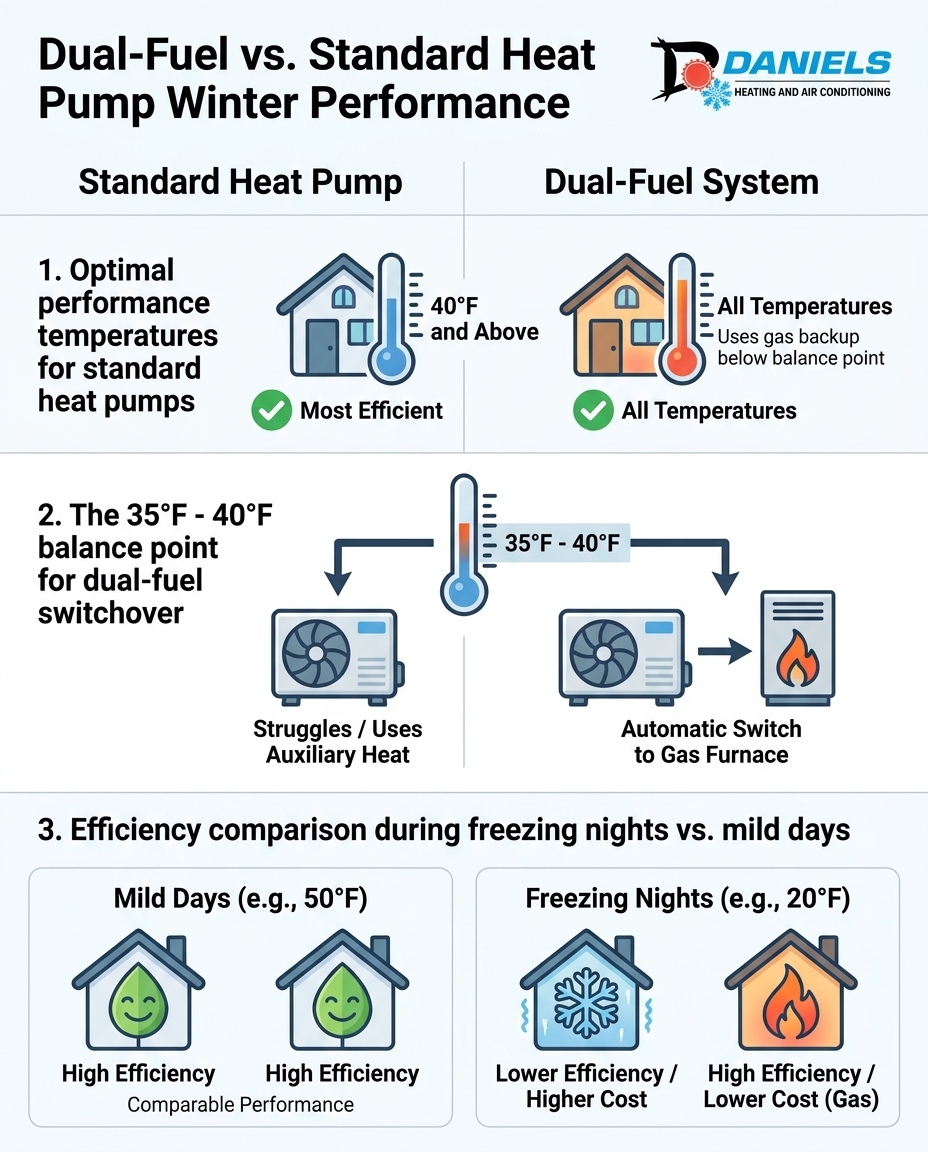
The core of a dual-fuel setup is a concept known as the "balance point." The balance point is the specific outdoor temperature at which the system automatically switches from the electric heat pump over to the gas furnace. Above this temperature, the heat pump handles the heating load because it is the most efficient method available. Once the outdoor temperature drops below the balance point, the system seamlessly transitions to gas heat.
This transition happens automatically through an advanced thermostat. You never have to manually flip a switch or monitor the weather forecast. The system constantly reads the outdoor temperature and selects the most efficient fuel source at any given moment. Because a gas furnace creates heat through combustion rather than extraction, it is entirely unaffected by freezing outdoor temperatures. It delivers powerful, consistent warmth to your registers regardless of how cold it gets outside.
Custom Calibration for Local Climates
The exact temperature of the balance point is not a one-size-fits-all number. It depends heavily on your home's insulation, your square footage, and local weather patterns. This is where our local expertise becomes highly valuable. Our team at Daniels Heating And Air Conditioning custom-calibrates the dual-fuel 'balance point' based on the specific climate data of our local service areas to maximize comfort and efficiency. By properly setting this switchover threshold during an October pre-winter replacement, our technicians ensure your system never runs the heat pump inefficiently and never burns gas unnecessarily.
Side-by-Side: Dual-Fuel vs. Standard Heat Pump
When weighing a dual-fuel system vs standard heat pump upgrade, looking at a direct comparison helps clarify the operational differences. Both systems will keep you warm, but they achieve that goal using very different methods under extreme conditions.
• Mild Weather Efficiency — Standard Heat Pump: Highly efficient; extracts ambient heat easily. — Dual-Fuel (Hybrid) System: Highly efficient; utilizes the exact same heat pump technology.
• Freezing Weather Operation — Standard Heat Pump: Relies on energy-intensive auxiliary electric heat strips. — Dual-Fuel (Hybrid) System: Switches to a gas furnace for powerful, efficient combustion heat.
• Air Temperature at the Register — Standard Heat Pump: Typically feels lukewarm (around 90°F - 95°F) during deep freezes. — Dual-Fuel (Hybrid) System: Delivers noticeably hotter air (often 110°F+) from the gas furnace.
• Defrost Cycles — Standard Heat Pump: Frequent defrost cycles required to melt outdoor coil ice. — Dual-Fuel (Hybrid) System: Minimal defrost cycles since the heat pump rests during freezes.
• Infrastructure Requirements — Standard Heat Pump: Requires standard high-voltage electrical connections. — Dual-Fuel (Hybrid) System: Requires both electrical connections and access to a natural gas or propane line.
Comparing Indoor Comfort
One of the most frequent observations our customers make after our team completes a hybrid upgrade is the difference in air temperature. Because a standard heat pump extracts heat, the air blowing out of your vents during a freeze might only be a few degrees warmer than your room temperature. It maintains the thermostat setting, but the air blowing on you can feel drafty. A dual-fuel system's gas furnace produces significantly hotter air, warming the living space faster and providing a cozier indoor environment.
System Lifespan and Winter Strain
Forcing a standard heat pump to run continuously through freezing nights puts immense wear and tear on the compressor. The frequent shifting in and out of defrost mode adds mechanical stress. Overworking a standard system in freezing weather can easily lead to sudden breakdowns, requiring you to navigate common HVAC emergencies and troubleshooting right when you need your heat the most—a pattern we see far too often during emergency calls. A dual-fuel system reduces this winter strain. By handing the heavy lifting over to the furnace during extreme cold, the heat pump compressor gets a break, which can positively impact the overall lifespan of the outdoor unit.
Evaluating Long-Term Efficiency and Utility Value
When planning a major home improvement, assessing the long-term value is just as important as the initial installation process. Dual-fuel systems typically have a different upfront installation profile than standard heat pumps because you are essentially installing two heating sources at once. However, our team consistently finds that the long-term winter utility efficiency justifies the investment, especially for homeowners who plan to stay in their property for years to come.
Utility Usage and Operational Efficiency
The primary value of a hybrid system lies in its operational flexibility. Electricity and natural gas rates fluctuate independently of each other. By utilizing the most efficient fuel source for the exact weather conditions outside, a dual-fuel system optimizes your energy consumption. You avoid the heavy electrical draw of auxiliary heat strips, relying instead on the steady, efficient combustion of the gas furnace during the coldest months.
Navigating Incentives and Infrastructure
Upgrading to high-efficiency heating technology often opens the door to various incentive programs. Generic federal tax credits and local utility rebates may apply to qualifying high-efficiency heat pump and dual-fuel installations. These programs are designed to encourage homeowners to adopt energy-saving technologies. Because program details, eligibility requirements, and deadlines change frequently, we strongly advise readers to verify current programs with a tax professional or their local utility provider.
Before committing to a hybrid system, you also need to evaluate your home's existing infrastructure. A dual-fuel system requires access to natural gas or a propane tank. If your home is entirely electric and does not currently have gas lines installed, adding that infrastructure will be an additional step in the upgrade process. Consulting with local experts is the best way to understand which system aligns seamlessly with your home's current capabilities. If you are located in Johnston County, exploring Smithfield HVAC services can connect you with professionals who understand both the local climate and municipal infrastructure requirements across the Smithfield and Goldsboro service areas.
Why Fall is the Ideal Time for Your Heating Upgrade
Timing your HVAC replacement strategically provides significant advantages. We see it every year: waiting for your heating system to fail in the middle of a January freeze leaves you scrambling for emergency replacements, often limiting your options to whatever equipment is currently sitting in a local warehouse. An October pre-winter replacement allows you to take control of the process.
Here is why scheduling your heating upgrade during the fall heating-startup season is the smartest move for homeowners:
1. Uninterrupted Winter Comfort: Completing an installation before the first major winter freeze ensures your home remains warm and safe without any stressful heating outages.
2. Access to Custom Solutions: Planning ahead gives you the time to properly evaluate a dual-fuel system vs standard heat pump upgrade, ensuring you get the exact equipment that matches your home's footprint and efficiency goals.
3. Avoiding the Emergency Rush: Fall installations allow you to schedule work on your own timeline, avoiding the frantic mid-winter rush when our technicians are swamped with emergency no-heat calls.
4. Immediate Protection: Pairing a new installation with a preventative maintenance plan protects your investment from day one, ensuring the newly calibrated balance point remains accurate and the system stays pristine year after year.
Proactive decision-making secures high-efficiency equipment before the cold weather sets in, giving you the entire winter season to enjoy the improved comfort and operational efficiency.
Frequently Asked Questions About Heat Pump Upgrades
At what temperature does a dual fuel heat pump switch to gas?
The exact switchover temperature, known as the balance point, is typically set between 35°F and 40°F. However, this is not a hard rule for every house. The balance point is custom-calibrated by a professional HVAC technician based on your home's specific insulation levels, square footage, and the local climate data. Proper calibration ensures the system transitions at the exact moment the heat pump begins to lose efficiency.
Is a dual fuel system better than a standard heat pump in North Carolina?
Whether a hybrid system is "better" depends entirely on your specific region and home infrastructure. In Eastern NC, the frequent freezing nights make dual-fuel systems highly effective for maintaining comfort and operational efficiency. While a standard heat pump is perfectly adequate for mild days, a dual-fuel system prevents the heavy reliance on inefficient electric heat strips during deep winter temperature drops.
How does a hybrid heat pump work during freezing nights?
When the outdoor temperature drops below the calibrated balance point, a hybrid heat pump automatically shuts off the outdoor compressor. The system then activates the indoor gas furnace. This transition provides powerful, consistent combustion heat to warm the home quickly, entirely avoiding the need to run the heat pump in freezing conditions or rely on auxiliary electric strips.
Are there tax credits available for dual-fuel system installations?
Yes, generic federal tax credits and various local utility rebates may apply to qualifying high-efficiency dual-fuel and standard heat pump installations. These incentives are designed to offset the cost of upgrading to energy-saving technology. Because these programs are subject to change, homeowners should always verify current eligibility requirements with a licensed HVAC professional and a qualified tax advisor.
Can I use my existing ductwork for a dual-fuel upgrade?
In most cases, existing ductwork can be utilized for a dual-fuel upgrade, provided it is in good condition. The ductwork must be properly sized for the new equipment, adequately sealed, and free of major leaks or blockages. A licensed HVAC technician will inspect your current ventilation system during the consultation to ensure it can handle the airflow and heat output of a modern hybrid system.
Secure Your Winter Comfort with an Expert Installation
Choosing the right heating equipment ultimately depends on balancing your efficiency goals, your home's existing infrastructure, and the specific demands of our local climate. While standard heat pumps offer excellent performance during mild fall weather, the advanced technology of a hybrid system provides unmatched operational efficiency during the freezing nights common to the Smithfield and Goldsboro service areas.
In our years of providing local HVAC solutions, we've found that the most effective way to determine which system fits your property is through a professional assessment. A detailed evaluation of your home's thermal envelope and current ductwork will reveal whether a standard unit or a hybrid approach offers the best long-term value. Do not wait for the first winter freeze to test your aging equipment. Schedule a professional consultation with our team today to secure a clear, regionally-grounded heating solution that will keep your household comfortable and efficient all season long.
hear what our satisfied
clients have to say


Service areas